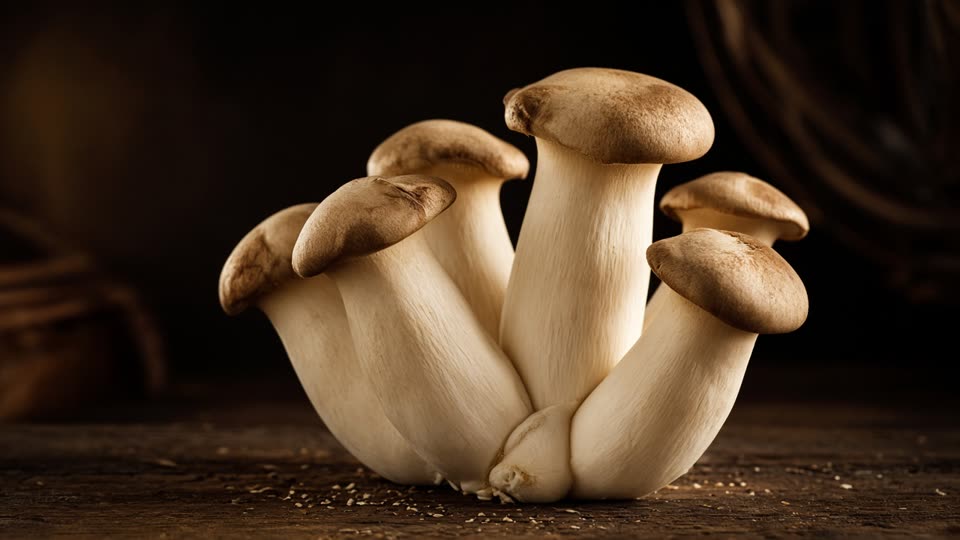
Culinary Profile
How to grow King Oyster at home
Pleurotus eryngii, King
Updated
King Oyster (Pleurotus eryngii), also called king trumpet or French horn mushroom, takes about 38 days to grow at home, from spawn to the end of the first harvest. Colonize at 22 °C (72 °F) in the dark, then fruit at 15 °C (59 °F) and 82% humidity with moderate fresh air and 12 h of light a day.
Thick-stem oyster. Cooler, slightly drier, and less fresh air than cluster oysters.
Use this profile on your chamber
What conditions does King Oyster need at each stage?
| Stage | Days | Temperature | Humidity | Fresh air | Light |
|---|---|---|---|---|---|
| Colonization | 18 | 22 °C (72 °F) | 88% | little fresh air: fan runs 15 s every 60 min | Dark |
| Pinning | 6 | 16 °C (61 °F) | 90% | moderate fresh air: fan runs 25 s every 25 min | 12 h a day, white 20%, blue 80% |
| Fruiting | 14 | 15 °C (59 °F) | 82% | moderate fresh air: fan runs 25 s every 25 min | 12 h a day, white 20%, blue 80% |
How long does King Oyster take to grow?
About 38 days from the start of colonization to the end of the first harvest window.
- Day 1 to 18: Colonization
- Day 19 to 24: Pinning
- Day 25 to 38: Fruiting
Let stems elongate before caps flare if you want steak-cut kings.
Get dates for each stage from your own start day with the grow timeline calculator, or compare every species in how long mushrooms take to grow.
Light recipe
Dark while it colonizes, then 12 h a day of cool white with some blue.
Light details
Same dark spawn run as other oysters. Fruiting is blue-heavy because P. eryngii primordia respond to blue light. Hours and white percent are the oyster default (12 h, 20% / 92 lux). No king-oyster-specific lux was found.
WS2812 blue is roughly 465 to 475 nm. The RGB mix is an approximation of cited wavelengths, not a measured spectrum.
| Phase | Hours on | White | RGB mix |
|---|---|---|---|
| colonization | 0 h on | white 0% | RGB 0 / 0 / 0 |
| fruiting | 12 h on | white 20% | RGB 0 / 0 / 80 |
| pinning | 12 h on | white 20% | RGB 0 / 0 / 80 |
What goes wrong when growing King Oyster?
What does this profile watch for?
High humidity plus lots of fresh air makes skinny kings. Keep humidity a bit lower once pins set.
No pins after colonization
Make sure the block is fully colonized first. Then check that the chamber reaches the pinning conditions: 16 °C (61 °F), 90% humidity, and moderate fresh air. Pins need more fresh air than colonization. More on this.
Dry, cracked, or curled caps
Usually humidity is too low, or air is blowing straight on the mushrooms. This profile holds 82% humidity while fruiting. More on this.
Green, black, or slimy patches
Patches that are not white mycelium are usually contamination such as green mold or bacteria. Bag the block, take it out of the chamber, and clean the chamber before the next grow. More on this.
Kit or block doing nothing? Work through grow kit not growing. To check your fresh air, put your chamber size and fan into the fresh air planner.
King Oyster growing FAQ
What temperature does King Oyster grow at?
In this profile King Oyster colonizes at 22 °C (72 °F) and fruits at 15 °C (59 °F). Colonization: 22 °C (72 °F). Pinning: 16 °C (61 °F). Fruiting: 15 °C (59 °F).
What humidity does King Oyster need?
82% while fruiting. Colonization: 88%. Pinning: 90%. Fruiting: 82%.
How long does King Oyster take to grow?
About 38 days with this profile: 18 days of colonization, 6 days of pinning, 14 days of fruiting. Real blocks vary, so move on when the block is ready, not only when the days run out.
How much light does King Oyster need?
Colonization: dark. Pinning: 12 h a day, white 20%, blue 80%. Fruiting: 12 h a day, white 20%, blue 80%.
How much fresh air does King Oyster need?
Moderate fresh air: fan runs 25 s every 25 min while fruiting. Colonization runs with little fresh air.
Related grow guides
- How to grow Golden Oyster: deep yellow
- How to grow King Oyster: thick-stem method
- How to grow Pearl Oyster: dark cap
- How to grow Blue Oyster
- How to grow mushrooms at home
- What is the easiest mushroom to grow at home?
- Grow kit vs monotub vs smart chamber
- How much humidity and fresh air do mushrooms need?
- All species and conditions
Download, rate, or report a grow
Sources
- Xie 2018 king oyster. Chunliang Xie et al., Comparative transcriptomics of Pleurotus eryngii reveals blue-light regulation of carbohydrate-active enzymes (CAZymes) at primordium differentiated into fruiting body stage, Genomics 110 (2018). Blue light induced primordium differentiation.
- Penn State oyster production. Daniel J. Royse, Cultivation of Oyster Mushrooms, Penn State College of Agricultural Sciences. First 12 to 21 days of spawn run may be completed without artificial lighting. After spawn run, 4 h of cool white fluorescent light at 50 to 300 lux may be provided. This recipe uses 12 h as a labeled default photoperiod, not a page-cited Stamets value, and maps 20% white to 92 lux, inside that 50 to 300 lux band.
- Stamets. Paul Stamets, Growing Gourmet and Medicinal Mushrooms, Ten Speed Press. Used here as a general cultivation reference. This recipe does not take a photoperiod or lux number from a cited page in that book.
- Sakamoto 2018. Yuichi Sakamoto, Influences of environmental factors on fruiting body induction, development and maturation in mushroom-forming fungi, Fungal Biology Reviews 32 (2018). Light is a fruiting cue for many basidiomycetes. Blue light is the usual photomorphogenesis signal. Agaricus bisporus is called out as not needing light for a cap. Flammulina velutipes can fruit in the dark as a long stem with a tiny cap.