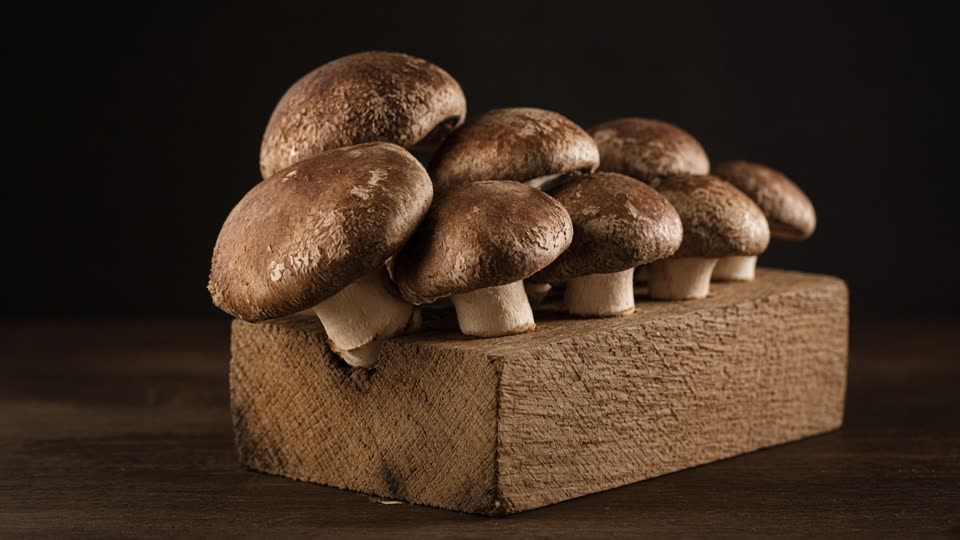
Culinary Profile
How to grow Shiitake at home
Lentinula edodes, Warm-weather block
Updated
Shiitake (Lentinula edodes), also called black forest mushroom or xiang gu, takes about 74 days to grow at home, from spawn to the end of the first harvest. Colonize at 24 °C (75 °F) in the dark, then fruit at 16 °C (61 °F) and 85% humidity with moderate fresh air and 12 h of light a day.
Needs a full colonize + browning rest, then a cold shock before fruiting.
Use this profile on your chamber
What conditions does Shiitake need at each stage?
| Stage | Days | Temperature | Humidity | Fresh air | Light |
|---|---|---|---|---|---|
| Colonization | 42 | 24 °C (75 °F) | 88% | little fresh air: fan runs 15 s every 60 min | Dark |
| Browning / skin | 21 | 21 °C (70 °F) | 80% | little fresh air: fan runs 20 s every 45 min | 12 h a day, white 26%, blue 80% |
| Cold shock (off-device) | 1 | 16 °C (61 °F) | 90% | little fresh air: fan runs 15 s every 60 min | Dark |
| Fruiting | 10 | 16 °C (61 °F) | 85% | moderate fresh air: fan runs 35 s every 12 min | 12 h a day, white 20%, blue 80% |
How long does Shiitake take to grow?
About 74 days from the start of colonization to the end of the first harvest window.
- Day 1 to 42: Colonization
Wait for full white, then browning: do not fruit early.
- Day 43 to 63: Browning / skin
Block forms a protective brown skin. Keep it a bit drier.
- Day 64: Cold shock (off-device)
The chamber can't get fridge cold. Shock 12 to 24 h at 5 to 10 °C, then apply fruiting.
- Day 65 to 74: Fruiting
Get dates for each stage from your own start day with the grow timeline calculator, or compare every species in how long mushrooms take to grow.
Light recipe
Dark while it colonizes, then 12 h a day of cool white with some blue.
Light details
Colonization stays dark (mycelium grows faster without strong light). The browning rest gets low light: 12 h at 26% white (about 200 lux) with the general blue mix. Browning of the block skin is light induced (Yoo 2019). Kim 2024 browned blocks under 40 to 60 days of blue or white light and cites high browning efficiency at 200 lux. Koo 2018 saw less browning at the highest intensities tested. Cold shock stays dark. Fruiting uses 12 h and the general 20% white / blue mix. Leatham found blue helped only on high-calcium media and suppressed fruiting on low-calcium media. Kim 2024 applied blue during incubation, not fruiting. No shiitake-specific fruiting lux for this chamber was found.
WS2812 blue is roughly 465 to 475 nm. The RGB mix is an approximation of cited wavelengths, not a measured spectrum.
| Phase | Hours on | White | RGB mix |
|---|---|---|---|
| colonization | 0 h on | white 0% | RGB 0 / 0 / 0 |
| fruiting | 12 h on | white 20% | RGB 0 / 0 / 80 |
| browning | 12 h on | white 26% | RGB 0 / 0 / 80 |
| cold_shock | 0 h on | white 0% | RGB 0 / 0 / 0 |
What goes wrong when growing Shiitake?
What does this profile watch for?
OpenShrooly cannot refrigerate a block. Cold-shock in a fridge, then return the block to the device.
No pins after colonization
Make sure the block is fully colonized first. Then check that the chamber reaches the cold shock (off-device) conditions: 16 °C (61 °F), 90% humidity, and little fresh air. Pins need more fresh air than colonization. More on this.
Dry, cracked, or curled caps
Usually humidity is too low, or air is blowing straight on the mushrooms. This profile holds 85% humidity while fruiting. More on this.
Green, black, or slimy patches
Patches that are not white mycelium are usually contamination such as green mold or bacteria. Bag the block, take it out of the chamber, and clean the chamber before the next grow. More on this.
Kit or block doing nothing? Work through grow kit not growing. To check your fresh air, put your chamber size and fan into the fresh air planner.
Shiitake growing FAQ
What temperature does Shiitake grow at?
In this profile Shiitake colonizes at 24 °C (75 °F) and fruits at 16 °C (61 °F). Colonization: 24 °C (75 °F). Browning / skin: 21 °C (70 °F). Cold shock (off-device): 16 °C (61 °F). Fruiting: 16 °C (61 °F).
What humidity does Shiitake need?
85% while fruiting. Colonization: 88%. Browning / skin: 80%. Cold shock (off-device): 90%. Fruiting: 85%.
How long does Shiitake take to grow?
About 74 days with this profile: 42 days of colonization, 21 days of browning / skin, 1 day of cold shock (off-device), 10 days of fruiting. Real blocks vary, so move on when the block is ready, not only when the days run out.
How much light does Shiitake need?
Colonization: dark. Browning / skin: 12 h a day, white 26%, blue 80%. Cold shock (off-device): dark. Fruiting: 12 h a day, white 20%, blue 80%.
How much fresh air does Shiitake need?
Moderate fresh air: fan runs 35 s every 12 min while fruiting. Colonization runs with little fresh air.
Related grow guides
- How to grow Shiitake: flower cap (huagu)
- How to grow Shiitake: thick winter cap (donko)
- How to grow Wood Ear: deep black
- How to grow Beech / Buna Shimeji
- How to grow mushrooms at home
- What is the easiest mushroom to grow at home?
- Grow kit vs monotub vs smart chamber
- How much humidity and fresh air do mushrooms need?
- All species and conditions
Download, rate, or report a grow
Sources
- Leatham and Stahmann 1987. Gary F. Leatham and Mark A. Stahmann, Effect of light and aeration on fruiting of Lentinula edodes, Trans. Br. Mycol. Soc. 88 (1987). Light is required for normal fruiting. Blue 400 to 500 nm stimulated fruiting on high-calcium media and suppressed fruiting on low-calcium media. Only pigmented primordia expanded.
- Kim 2024 shiitake blue light. Min-Jun Kim et al., Effects of Blue Light on Fruiting Body Production and Ergothioneine Content During Sawdust Cultivation of Shiitake, Mycobiology (2024). Blocks were incubated 60 days in the dark, then 40 to 60 days under blue or white LED at 4 umol/m2/s, and browning happened in that light period. The paper cites Park et al. 2017 (J. Mushrooms 15) for high browning efficiency at 200 lux regardless of light source. Blue light was applied during incubation, not during fruiting. Yield and ergothioneine rose versus white in two cultivars. This recipe does not treat that as a fruiting-stage blue mix.
- Koo 2018 shiitake browning LED. Jinmo Koo et al., Browning technology for shiitake in sawdust using LED source, Journal of Mushrooms 16(4) (2018). Light was used to induce browning on a 1 h on, 1 h off cycle at 20 C for 60 days. The best browning came at 1.5 umol/m2/s red and blue LED; the strongest settings tested (20.5 umol/m2/s and 300 lux fluorescent) browned less. The chamber has one daily light window, so 12 h at about 200 lux stands in for that cycle.
- Yoo 2019 shiitake browning transcriptome. Sung-Il Yoo et al., Comparative transcriptome analysis identified candidate genes involved in mycelium browning in Lentinula edodes, BMC Genomics 20 (2019). Describes light-induced brown film formation on the mycelium as an important process for shiitake yield and quality.
- Stamets. Paul Stamets, Growing Gourmet and Medicinal Mushrooms, Ten Speed Press. Used here as a general cultivation reference. This recipe does not take a photoperiod or lux number from a cited page in that book.
- Sakamoto 2018. Yuichi Sakamoto, Influences of environmental factors on fruiting body induction, development and maturation in mushroom-forming fungi, Fungal Biology Reviews 32 (2018). Light is a fruiting cue for many basidiomycetes. Blue light is the usual photomorphogenesis signal. Agaricus bisporus is called out as not needing light for a cap. Flammulina velutipes can fruit in the dark as a long stem with a tiny cap.
- General default. No variety-specific photoperiod or lux was found for this species. Colonization is dark (Sakamoto 2018; Penn State oyster spawn run). Fruiting uses 12 h as a labeled default, not a page-cited Stamets value, and 20% white, which is 92 lux on this chamber, inside the Penn State oyster 50 to 300 lux band. Blue 80% approximates the 440 to 470 nm finding. This is a labeled default, not a measured value for this variety.