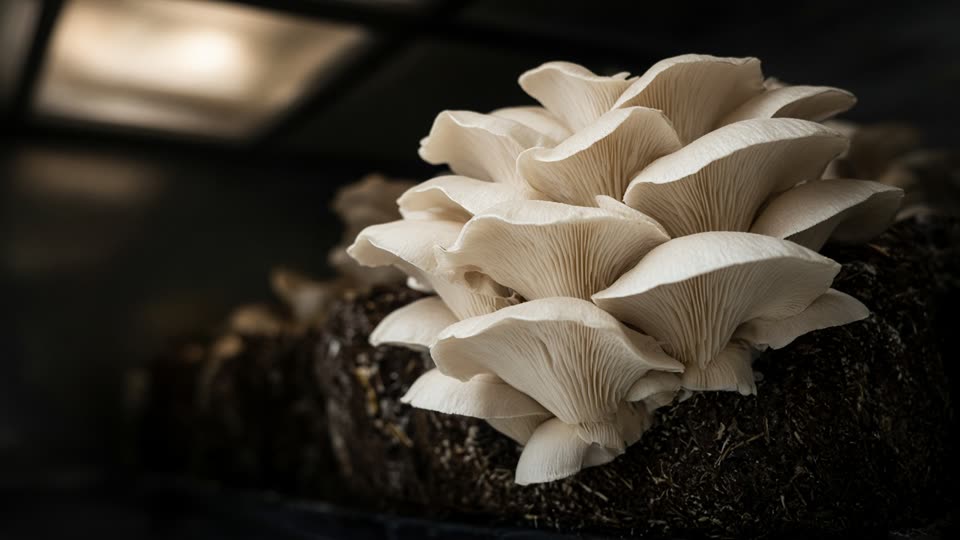
Culinary Profile
How to grow Pearl Oyster at home
Pleurotus ostreatus, Pearl
Updated
Pearl Oyster (Pleurotus ostreatus), also called oyster mushroom or hiratake, takes about 29 days to grow at home, from spawn to the end of the first harvest. Colonize at 24 °C (75 °F) in the dark, then fruit at 16 °C (61 °F) and 88% humidity with moderate fresh air and 12 h of light a day.
Forgiving beginner oyster. Fast, lots of fresh air, cool-to-room fruiting.
Use this profile on your chamber
What conditions does Pearl Oyster need at each stage?
| Stage | Days | Temperature | Humidity | Fresh air | Light |
|---|---|---|---|---|---|
| Colonization | 14 | 24 °C (75 °F) | 90% | little fresh air: fan runs 15 s every 60 min | Dark |
| Pinning | 5 | 18 °C (64 °F) | 93% | moderate fresh air: fan runs 35 s every 15 min | 12 h a day, white 20%, blue 80% |
| Fruiting | 10 | 16 °C (61 °F) | 88% | moderate fresh air: fan runs 40 s every 10 min | 12 h a day, white 20%, blue 80% |
How long does Pearl Oyster take to grow?
About 29 days from the start of colonization to the end of the first harvest window.
- Day 1 to 14: Colonization
Dark, little fresh air until the block is white.
- Day 15 to 19: Pinning
Drop temperature and add fresh air to trigger clusters.
- Day 20 to 29: Fruiting
Harvest when caps flatten and edges just begin to upturn.
Get dates for each stage from your own start day with the grow timeline calculator, or compare every species in how long mushrooms take to grow.
Light recipe
Dark while it colonizes, then 12 h a day of cool white with some blue.
Light details
Colonization stays dark, as in Penn State spawn-run rooms. Fruiting uses 12 h and a blue-heavy mix because P. ostreatus aggregates and forms caps under 440 to 470 nm light. White 20% is 92 lux on this strip, inside the Penn State 50 to 300 lux band.
WS2812 blue is roughly 465 to 475 nm. The RGB mix is an approximation of cited wavelengths, not a measured spectrum.
| Phase | Hours on | White | RGB mix |
|---|---|---|---|
| colonization | 0 h on | white 0% | RGB 0 / 0 / 0 |
| fruiting | 12 h on | white 20% | RGB 0 / 0 / 80 |
| pinning | 12 h on | white 20% | RGB 0 / 0 / 80 |
What goes wrong when growing Pearl Oyster?
What does this profile watch for?
Shrooly-sized chamber works well. Keep surfaces just barely glistening, not dripping.
No pins after colonization
Make sure the block is fully colonized first. Then check that the chamber reaches the pinning conditions: 18 °C (64 °F), 93% humidity, and moderate fresh air. Pins need more fresh air than colonization. More on this.
Long, thin stems and small caps
This usually means too little fresh air. This profile runs moderate fresh air: fan runs 40 s every 10 min while fruiting. More on this.
Dry, cracked, or curled caps
Usually humidity is too low, or air is blowing straight on the mushrooms. This profile holds 88% humidity while fruiting. More on this.
Green, black, or slimy patches
Patches that are not white mycelium are usually contamination such as green mold or bacteria. Bag the block, take it out of the chamber, and clean the chamber before the next grow. More on this.
Kit or block doing nothing? Work through grow kit not growing. To check your fresh air, put your chamber size and fan into the fresh air planner.
Pearl Oyster growing FAQ
What temperature does Pearl Oyster grow at?
In this profile Pearl Oyster colonizes at 24 °C (75 °F) and fruits at 16 °C (61 °F). Colonization: 24 °C (75 °F). Pinning: 18 °C (64 °F). Fruiting: 16 °C (61 °F).
What humidity does Pearl Oyster need?
88% while fruiting. Colonization: 90%. Pinning: 93%. Fruiting: 88%.
How long does Pearl Oyster take to grow?
About 29 days with this profile: 14 days of colonization, 5 days of pinning, 10 days of fruiting. Real blocks vary, so move on when the block is ready, not only when the days run out.
How much light does Pearl Oyster need?
Colonization: dark. Pinning: 12 h a day, white 20%, blue 80%. Fruiting: 12 h a day, white 20%, blue 80%.
How much fresh air does Pearl Oyster need?
Moderate fresh air: fan runs 40 s every 10 min while fruiting. Colonization runs with little fresh air.
Is Pearl Oyster good for beginners?
Yes. It is tagged beginner in this library, which means it is one of the more forgiving species to start with.
Related grow guides
- How to grow Blue Oyster
- How to grow Pearl Oyster: baby clusters
- How to grow Pink Oyster
- How to grow Pink Oyster: bright pink
- How to grow mushrooms at home
- What is the easiest mushroom to grow at home?
- Grow kit vs monotub vs smart chamber
- How much humidity and fresh air do mushrooms need?
- All species and conditions
Download, rate, or report a grow
Sources
- Penn State oyster production. Daniel J. Royse, Cultivation of Oyster Mushrooms, Penn State College of Agricultural Sciences. First 12 to 21 days of spawn run may be completed without artificial lighting. After spawn run, 4 h of cool white fluorescent light at 50 to 300 lux may be provided. This recipe uses 12 h as a labeled default photoperiod, not a page-cited Stamets value, and maps 20% white to 92 lux, inside that 50 to 300 lux band.
- Richartz and MacLellan 1987 action spectrum. Gisela Richartz and Andrew J. MacLellan, Action spectra for hyphal aggregation, the first stage of fruiting, in Pleurotus ostreatus, Photochemistry and Photobiology 45 (1987). Peaks at 370 nm and 440 to 450 nm. Wavelengths longer than 530 nm gave no response.
- Wang 2020 blue versus red. Hao Wang et al., Transcriptomic profiling sheds light on the blue-light and red-light response of oyster mushroom (Pleurotus ostreatus), AMB Express 10 (2020). Blue LED 430 to 470 nm at about 50 umol/m2/s improved cap growth. Red 610 to 640 nm did not.
- De Bonis 2024 LED wavelengths. Marina De Bonis et al., Effect of Different LED Light Wavelengths on Production and Quality of Pleurotus ostreatus, Horticulturae 10 (2024), with Penn State co-authors. 450 nm blue increased cap diameter versus red 610 nm.
- Stamets. Paul Stamets, Growing Gourmet and Medicinal Mushrooms, Ten Speed Press. Used here as a general cultivation reference. This recipe does not take a photoperiod or lux number from a cited page in that book.