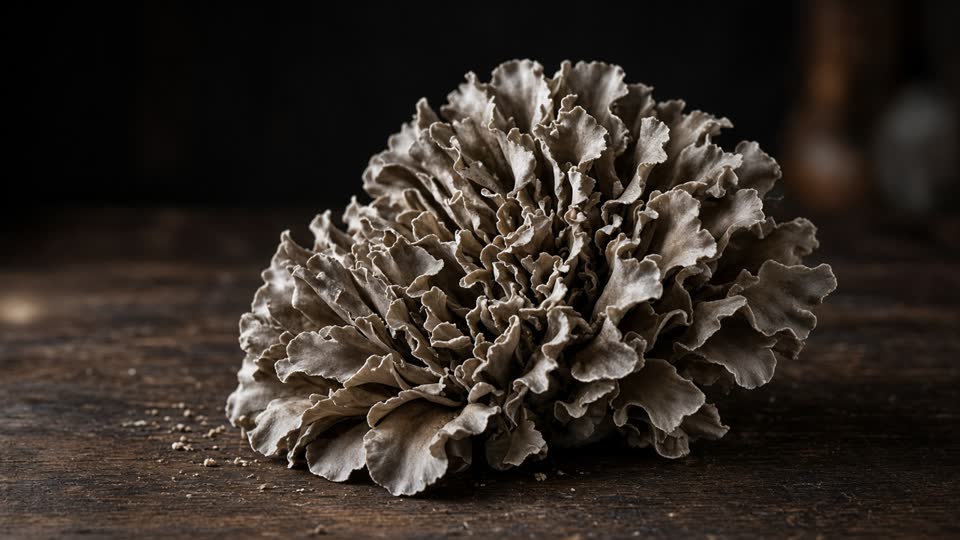
Culinary Profile
How to grow Maitake at home
Grifola frondosa, Hen of the woods
Updated
Maitake (Grifola frondosa), also called hen of the woods or sheep's head, takes about 54 days to grow at home, from spawn to the end of the first harvest. Colonize at 22 °C (72 °F) in the dark, then fruit at 16 °C (61 °F) and 88% humidity with moderate fresh air and 12 h of light a day.
Slow woodlover. Primordia look like brains; do not dry them out.
Use this profile on your chamber
What conditions does Maitake need at each stage?
| Stage | Days | Temperature | Humidity | Fresh air | Light |
|---|---|---|---|---|---|
| Colonization | 28 | 22 °C (72 °F) | 90% | little fresh air: fan runs 15 s every 60 min | Dark |
| Primordia | 10 | 17 °C (63 °F) | 93% | moderate fresh air: fan runs 20 s every 25 min | 12 h a day, white 37% |
| Fruiting | 16 | 16 °C (61 °F) | 88% | moderate fresh air: fan runs 25 s every 20 min | 12 h a day, white 37% |
How long does Maitake take to grow?
About 54 days from the start of colonization to the end of the first harvest window.
- Day 1 to 28: Colonization
- Day 29 to 38: Primordia
- Day 39 to 54: Fruiting
Get dates for each stage from your own start day with the grow timeline calculator, or compare every species in how long mushrooms take to grow.
Light recipe
Dark while it colonizes, then 12 h a day of cool white.
Light details
Colonization is dark. Fruiting uses 12 h (Kurahashi 2015) and 37% white, mapped from the 500 lux yield optimum in Chi 2008. That trial found white outyielded blue and green, so RGB stays off and the white channel carries the light. Blue is not used because it conflicted with that yield result.
WS2812 blue is roughly 465 to 475 nm. The RGB mix is an approximation of cited wavelengths, not a measured spectrum.
| Phase | Hours on | White | RGB mix |
|---|---|---|---|
| colonization | 0 h on | white 0% | RGB 0 / 0 / 0 |
| fruiting | 12 h on | white 37% | RGB 0 / 0 / 0 |
| pinning | 12 h on | white 37% | RGB 0 / 0 / 0 |
What goes wrong when growing Maitake?
No pins after colonization
Make sure the block is fully colonized first. Then check that the chamber reaches the primordia conditions: 17 °C (63 °F), 93% humidity, and moderate fresh air. Pins need more fresh air than colonization. More on this.
Dry, cracked, or curled caps
Usually humidity is too low, or air is blowing straight on the mushrooms. This profile holds 88% humidity while fruiting. More on this.
Green, black, or slimy patches
Patches that are not white mycelium are usually contamination such as green mold or bacteria. Bag the block, take it out of the chamber, and clean the chamber before the next grow. More on this.
Kit or block doing nothing? Work through grow kit not growing. To check your fresh air, put your chamber size and fan into the fresh air planner.
Maitake growing FAQ
What temperature does Maitake grow at?
In this profile Maitake colonizes at 22 °C (72 °F) and fruits at 16 °C (61 °F). Colonization: 22 °C (72 °F). Primordia: 17 °C (63 °F). Fruiting: 16 °C (61 °F).
What humidity does Maitake need?
88% while fruiting. Colonization: 90%. Primordia: 93%. Fruiting: 88%.
How long does Maitake take to grow?
About 54 days with this profile: 28 days of colonization, 10 days of primordia, 16 days of fruiting. Real blocks vary, so move on when the block is ready, not only when the days run out.
How much light does Maitake need?
Colonization: dark. Primordia: 12 h a day, white 37%. Fruiting: 12 h a day, white 37%.
How much fresh air does Maitake need?
Moderate fresh air: fan runs 25 s every 20 min while fruiting. Colonization runs with little fresh air.
Is Maitake good for beginners?
It is one of the harder species in this library. Try an oyster first if you have never grown before.
Related grow guides
- How to grow Shiitake: flower cap (huagu)
- How to grow Shiitake: thick winter cap (donko)
- How to grow Button / Cremini
- How to grow Cordyceps militaris
- How to grow mushrooms at home
- What is the easiest mushroom to grow at home?
- Grow kit vs monotub vs smart chamber
- How much humidity and fresh air do mushrooms need?
- All species and conditions
Download, rate, or report a grow
Sources
- Chi et al. 2008 maitake. Jeong-Hyun Chi et al., Studies on Favorable Light Condition for Artificial Cultivation of Grifola frondosa, Korean J. Mycology 36 (2008). White light outyielded blue and green. Primordia formed best at 200 lux. Yield was best at 500 lux. 500 lux maps to 37% white.
- Kurahashi et al. 2015. Atsushi Kurahashi et al., A putative transcription factor Gf.BMR1 in Grifola frondosa, the homolog of BMR1 in Bipolaris oryzae, was strongly induced by near-ultraviolet light and blue light, Mycoscience 56 (2015). Fruiting used a 12 h light / 12 h dark cycle under a white fluorescent lamp, then compared 463 nm blue LED and near-UV. Dark-grown caps stayed pale and antler-like.
- Sakamoto 2018. Yuichi Sakamoto, Influences of environmental factors on fruiting body induction, development and maturation in mushroom-forming fungi, Fungal Biology Reviews 32 (2018). Light is a fruiting cue for many basidiomycetes. Blue light is the usual photomorphogenesis signal. Agaricus bisporus is called out as not needing light for a cap. Flammulina velutipes can fruit in the dark as a long stem with a tiny cap.